Message from Uzair Sattar, Founder

“In honor of World Password Day, which is celebrated on the first Thursday in May, we’re dedicating this newsletter to the importance of creating strong passwords that offer greater security for minimal effort.  First started by Intel, World Password Day brings awareness to password security and protection, strong password habits, and best practices to secure personal and corporate data. Also, we recently launched a new updated website, please check it out here.”

— Uzair

Honoring World Password Day—Keep Your Password Under Lock and Key

You can buy a small padlock for less than a dollar—but you shouldn’t count on it to protect anything of value. A thief could probably pick a cheap lock without much effort, or simply break it. And yet, many people and organizations use similarly flimsy passwords to “lock up” their most valuable assets, including money and confidential information.

Fortunately, everyone can learn how to make and manage stronger passwords. It’s an easy way to strengthen security both at work and at home.

What Makes a Password ‘Strong’?

Here’s an example to make our point about passwords: Let’s say you need to create a new password that’s at least 12 characters long, and includes numerals, symbols, and upper- and lowercase letters. Now think of a word you can remember, capitalize the first letter, add a digit, and end with an exclamation point. The result: Strawberry1!

Unfortunately, hackers have sophisticated password-breaking tools that can easily defeat passwords based on dictionary words (like “strawberry”) and common patterns, such as capitalizing the first letter.

Password Complexity Matters

Increasing a password’s complexity, randomness, and length can make it more resistant to hackers’ tools. For example, an eight-character password could be guessed by an attacker in less than a day, but a 12-character password would take two weeks. A 20-character password would take 21 centuries.

At ICE Consulting, we suggest that you take advantage of your organization’s security awareness training. They can offer some guidelines and/or may already have a password policy in place. If your organization, doesn’t have this, we suggest talking to ICE Consulting today.

Make Your Password Unique

Many people reuse passwords across multiple accounts, and attackers take advantage of this risky behavior. If an attacker obtains one password—even a strong one—they can often use it to access other valuable accounts.

Here’s a real-life example: Ten years ago, Alice joined an online gardening forum. She also created an online payment account and used the same password. She soon forgot about the gardening forum, but someone accessed her payments account years later and stole a large sum of money.

Alice didn’t realize the gardening forum had been hacked, and that users’ login credentials had been leaked online. An attacker probably tried reusing Alice’s leaked password on popular sites—and eventually got lucky.

Three Ways to Guard Your Passwords

  1. Don’t write them down – Many make the mistake of writing passwords on post-it notes and leaving them in plain sight. Even if you hide your password, someone could still find it. Similarly, don’t store your login information in a file on your computer, even if you encrypt that file.
  2. Don’t share passwords – You can’t be sure someone else will keep your credentials safe. At work, you could be held responsible for anything that happens when someone is logged in as you.
  3. Don’t save login details in your browser – Some browsers store this information in unsafe ways, and another person could access your accounts if they get your device.


Tips for Family and Friends

Consider sharing what you’ve learned about passwords and ask family and friends about their cybersecurity knowledge or experiences.

  1. Never reuse passwords – Create a unique, strong password for each account or device. This way, a single hacked account doesn’t endanger other accounts.
  2. Create complex, long passwords – Passwords based on dictionary words, pets’ names, or other personal information can be guessed by attackers.
  3. Use a password manager – These tools can securely store and manage your passwords and generate strong new passwords. Some can also alert you if a password may have been compromised.

Managing Pins and Passwords

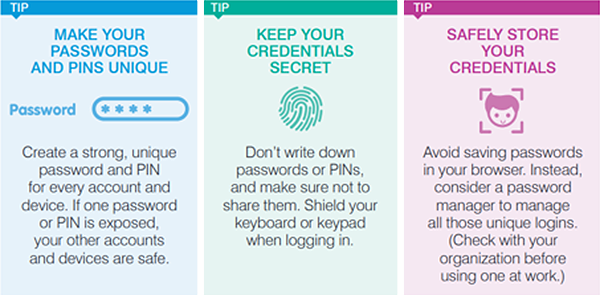
Passwords and PINs protect sensitive data and it’s critical to keep them safe. Try these three best practices:

3 Tips to Stay Safe


ICE Consulting is a proud partner of California LIfe Sciences (CLS) and has more than 25 years of biotech and life sciences expertise. We are also Managed IT and Cybersecurity Service Provider for the Biocom Community.

Learn more about our security offerings. Security Operations Center-as-a-Service (SOCaaS) can shift your security posture away from one with only reactive responses to events to a proactive model with complete visibility into your IT environment as well as vulnerability management before breaches occur. This is critically important in today’s world. 

ICE Motto of the Month

We’re all in this together. We’ll get through it together — and stronger than before.

Have questions about our services?
Contact us at 408-701-5777 or email info@iceconsulting.com

Headquarters | Silicon Valley 1900 McCarthy Blvd. Suite 300
Milpitas CA 95035 | (888) 423-4801

Milpitas •  San Ramon • San Francisco  •  Los Angeles  •  Asia Office

Unsubscribe

© 2022 ICE Consulting, Inc. All rights reserved.